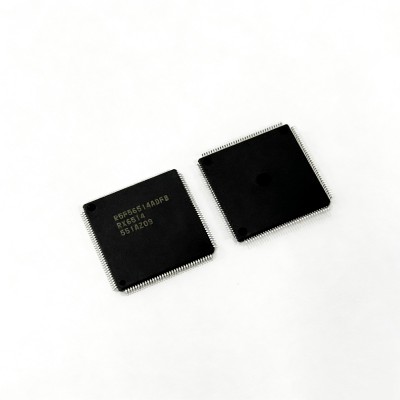

产品详情
Features
■ 32-bit RXv2 CPU core
Max. operating frequency: 120 MHz
Capable of 240 DMIPS in operation at 120 MHz
Single precision 32-bit IEEE-754 floating point
Two types of multiply-and-accumulation unit (between memories
and between registers)
32-bit multiplier (fastest instruction execution takes one CPU clock
cycle)
Divider (fastest instruction execution takes two CPU clock cycles)
Fast interrupt
CISC Harvard architecture with 5-stage pipeline
Variable-length instructions: Ultra-compact code
Supports the memory protection unit (MPU)
JTAG and FINE (one-line) debugging interfaces
■ Low-power design and architecture
Operation from a single 2.7- to 3.6-V supply
Low power consumption: A product that supports all peripheral
functions draws only 0.19 mA/MHz (Typ.).
RTC is capable of operation from a dedicated power supply.
Four low-power modes
■ On-chip code flash memory
Supports versions with up to 2 Mbytes of ROM
No wait cycles at up to 50 MHz or when the ROM cache is hit, one-
wait state at up to 100 MHz, two-wait state at above 100 MHz
User code is programmable by on-board or off-board programming.
Programming/erasing as background operations (BGOs)
A dual-bank structure allows exchanging the start-up bank.
■ On-chip data flash memory
32 Kbytes, reprogrammable up to 100,000 times
Programming/erasing as background operations (BGOs)
■ On-chip SRAM, no wait states
256K/640 Kbytes of SRAM (no wait states)
8 Kbytes of standby RAM (backup on deep software standby)
■ Data transfer
DMACAa: 8 channels
DTCb: 1 channel
EXDMAC: 2 channels
DMAC for the Ethernet controller: 1 channel
■ Reset and supply management
Power-on reset (POR)
Low voltage detection (LVD) with voltage settings
■ Clock functions
External crystal resonator or internal PLL for operation at 8 to 24
MHz
Internal 240-kHz LOCO and HOCO selectable from 16, 18, and 20
MHz
120-kHz clock for the IWDTa
■ Real-time clock
Adjustment functions (30 seconds, leap year, and error)
Real-time clock counting and binary counting modes are selectable
Time capture function
(for capturing times in response to event-signal input)
■ Independent watchdog timer
120-kHz (1/2 LOCO frequency) clock operation


 浙公网安备 33010502000757号